
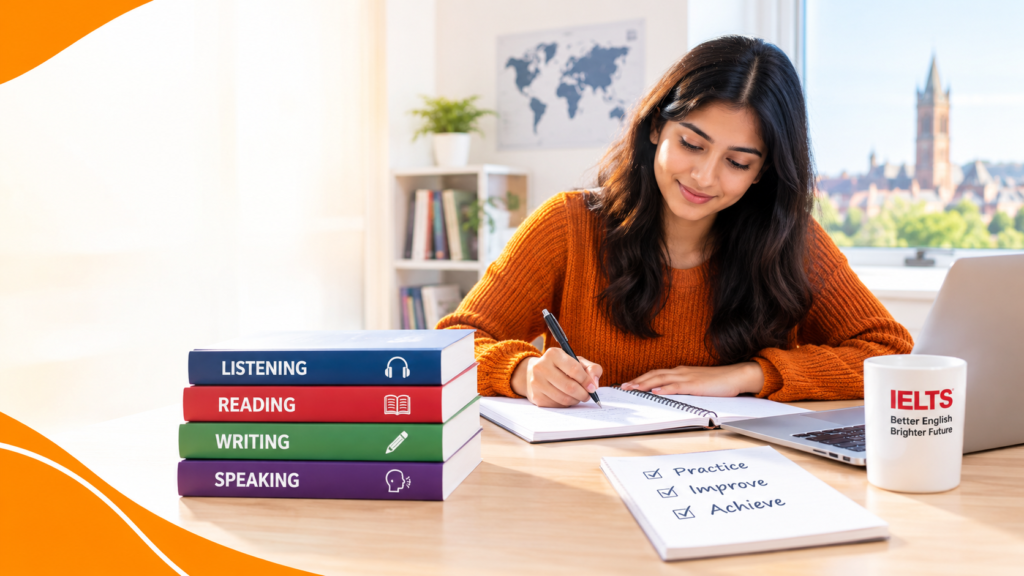
Starting IELTS Preparation in Leicester can feel like a lot when you don’t know where to begin. You might want a place at a UK university. A job or a visa might ask for an English score. Or you might plan to move to another country with your family.
Whatever your goal, the IELTS test is a big step, and a clear plan makes it feel smaller. Whether you plan to take the Academic test or the General Training test, this guide covers what you need to know. Many people in Leicester speak two or three languages, and that is a big strength. But the test has its own style. It asks you to read, write, listen and speak in a set way, with strict timing. Knowing that style is half the work.
This guide walks you through it in plain words. You’ll learn what is on the test, what the different courses look like, how a tutor can help, why practice papers matter and how to build a study plan that fits your week. We kept the tips short so you can try them at home. Read from top to bottom, or jump to the part you need.
The short version
Table of Contents
Let’s start with the basics. The test has four parts, and each part checks a different skill.
IELTS is offered on paper and on computer. The test content and scoring are the same. The difference is how you answer Listening, Reading and Writing: you type on a computer or write on paper. Some test centres are moving all tests to computer, and the timing differs from place to place. Ask your test centre which version you can book.
Results for IELTS on computer are available 1 to 5 days after you finish all parts of the test. Paper results take about two weeks. Each part gets a score from 0 to 9, and the four scores make your overall score. Each university or employer sets its own target. For official details, visit the IELTS website.
IELTS comes in two types, and picking the wrong one can cost you time and money.
Academic is for study at university level and for professional registration. General Training is for work, training courses below degree level, school study and moving to some countries. Listening and Speaking are the same in both. Reading and Writing are different. In Academic Writing Task 1, you describe a graph, chart or diagram. In General Training, you write a letter.
The right choice depends on who asks for your score. Read their instructions and ask them if you are not sure. Some UK visa routes need IELTS for UKVI, which is a Home Office approved test taken at an approved centre. Other approved tests exist as well. The GOV.UK guidance on secure English language tests lists the tests and centres.
When choosing an IELTS course, think about your current English level, your test date and how you prefer to learn. Bright Learning Centre offers classroom-based and online or distance learning options, so you can discuss which method suits your needs.
The centre asks prospective learners to attend an initial assessment before booking. This gives you a chance to discuss your learning needs and find out more about the course.
Before choosing any course, ask how much practice you will receive, how tutors give feedback and which materials are included. These details can help you decide whether the course fits your preparation needs.
A tutor can save you weeks of guessing. A good one finds your weak spots and builds each lesson around them.
Say you speak English at work all day. You might lose marks in Writing, because the test wants a clear plan, linked ideas and correct grammar. A tutor can spot this in the first lesson. Your tutor listens to you speak, reads your essays and explains how examiners give marks. Books and videos can teach you the rules, but one-to-one feedback shows how those rules apply to your own answers. Before you book, ask these questions.
A mock test shows you where you stand and what to fix. It is one of the best ways to get ready.
Good IELTS mock tests in Leicester use the same timing, the same number of questions and the same rules as test day. You sit in a quiet room with no phone and no extra time. If you plan to take the computer test, try at least one mock test on a screen with headphones, so test day feels familiar.
A mock test is practice. It helps you track your progress, but it does not give you an official IELTS result. A teacher’s mark on your Writing and Speaking is a guide to what to fix, not a promise of your test score. Only an official test centre can give you a score for an application.
Take your first mock test at the start of your course. A low score is normal on the first try, and it tells you where to begin. Take another every two weeks, and one each week as your test date gets close. After each test, go through your mistakes. Write down every wrong answer and find the cause. Did you miss a spelling? Hear a word wrong? Run out of time? Fix one cause at a time, and your next practice score may show the change.
These two skills need good habits and a steady pace. A few small changes can make a big difference.
The recording plays one time, and you can’t replay it. Try these steps.
Reading is a race against the clock, so a plan for your time helps. Here is one you can follow.
People mark these two parts, so clear and organised answers earn more. Good habits here come from practice and feedback.
Good IELTS writing is clear, organised and on topic. Keep these points in mind.
Here are two examples you can copy for practice.
Task 1 opening (Academic): A good first sentence tells the reader what the chart shows, such as “The chart shows how many people joined evening classes between 2020 and 2025.” Follow it with the main trend and two or three key numbers.
Task 2 plan: Take this practice question: “Some people think children should start learning a second language at primary school. Do you agree or disagree?” A short plan could be: agree; young children pick up new sounds with ease; an early start gives more years of practice; one example of a child who hears two languages at home and at school. Write four short paragraphs from this plan.
The examiner wants to hear you talk with ease, so relax and be yourself.
Here is an example of a short answer that becomes a better one. The question is “Do you work or study?” A short answer is “I work.” A better answer is “I work in a shop in Leicester. I like it because I meet people from many countries, and it helps me practise English every day.” The second answer gives a reason and a detail.
A plan turns a big goal into small steps. Here is an eight-week plan to use as a starting point. It is a suggested study plan, not the official duration of the IELTS course at Bright Learning Centre, where course length depends on your needs.
How long you need depends on your current English level, your target score and the time you have. After your first mock test, compare each part with your target and change the plan to match.
A teacher or tutor can help you set a goal that fits your level. Study five or six days each week. A short session each day is better than one long session at the weekend.
Here are clear answers to common questions about the test, courses and costs.
It depends on your starting level, your target score and the time you have each week. The eight-week plan above is a guide. A bigger gap needs more time, and nobody can promise a score.
Yes. Many people use practice papers and sample tasks from the official IELTS website. The hard part is feedback. It is difficult to judge your own Writing and Speaking, so a tutor or class can help you see what to fix.
Four to six full mock tests over eight weeks is a good guide. Take one at the start, one every two weeks, and one each week near your test date. Review your mistakes after each one.
Start with your test type, Academic or General Training, and your test date. Then ask how the course gives feedback on Writing and Speaking, which learning options it offers, and whether practice tests are part of the price. Ask the provider to confirm that the course covers IELTS and not a different English test. An initial assessment or trial lesson is a good way to compare options.
Listening and Speaking are the same. Reading and Writing differ. Academic uses texts and tasks about study topics, and Writing Task 1 describes a chart or diagram. General Training uses everyday and work texts, and Writing Task 1 is a letter. Check which one your university, employer or visa office asks for.
Each university, employer or visa office sets its own score. Some ask for a minimum in each part, as well as an overall score. Check their website or ask them before you book. For UK visas, check the rules for your route on GOV.UK.
The test fee and the course fee are separate. The test fee is set on the official booking page for your test centre. Course prices change with the length of the course and the way you study. Ask for a written quote that lists the hours, the study materials, the mock tests and any extra fees.
Both versions exist, and what you can book depends on your location and test centre. The content and scoring are the same. Computer results are available in 1 to 5 days after you finish all parts, and paper results take about two weeks. Ask your test centre which version your booking uses.
Yes, if you took IELTS on computer. IELTS One Skill Retake lets you resit one of the four parts. You need to have your results and book within 60 days of your full test. It is not available in every country or centre, and paper test takers can’t use it. Acceptance also varies. Universities, employers and visa authorities set their own rules. UKVI accepts it for some computer tests in selected locations. Read the IELTS One Skill Retake page and ask the organisation that needs your score before you book.
Yes. Bright Learning Centre lists classroom-based and online or distance learning options for IELTS preparation. Contact the centre to confirm the current arrangements, the support available and the learning materials.
Yes. Bright Learning Centre offers classroom-based IELTS preparation in Leicester. The course covers Listening, Reading, Writing and Speaking, with practice exercises and test preparation guidance.
Yes. The centre asks prospective learners to attend an initial assessment before booking. Contact the centre to arrange your assessment and discuss your preparation needs.
The course has a flexible duration that depends on your learning needs. Contact Bright Learning Centre to discuss your current English level, your target score and a suitable preparation plan.
Learners book the exam through a local exam centre, and the centre can help with test booking. Contact the centre to confirm the support it offers now and to check which test you need to take.
The centre lists basic English reading, writing, speaking and listening skills, equal to Level 1 Functional Skills in Literacy, as its entry requirement. Contact the centre if you need help to understand your current level.
Good IELTS Preparation in Leicester starts with understanding your target score, practising all four test skills and learning from your mistakes. A clear study plan and regular feedback can help you identify areas that need more work.
Bright Learning Centre offers classroom-based and online or distance learning options for IELTS preparation, with tutor support and practice materials. An initial assessment helps you discuss your learning needs before booking.