If you look after babies and young children, a paediatric first aid course is the one to start with. The names “paediatric first aid” and “emergency first aid at work” sound so alike that most people assume they’re the same course. They’re not, and the mix-up is very common. Both teach you how to help someone who is hurt or ill until a doctor or an ambulance arrives. The difference is who you’re learning to help. One course is built around babies and children. The other is built around adults at work. It matters, because picking the wrong one can leave you without the certificate your role needs. A childminder in England, for example, must hold a paediatric first aid certificate to register with Ofsted. A first aider in an office or shop usually needs the workplace course instead. In this guide, we’ll go through what each course teaches, how long it takes, how long the certificate lasts and who it’s meant for. You don’t need to be ready to book anything. This is simply here to help you understand your options.
Table of Contents
Paediatric first aid is about knowing what to do when a baby or child needs help.
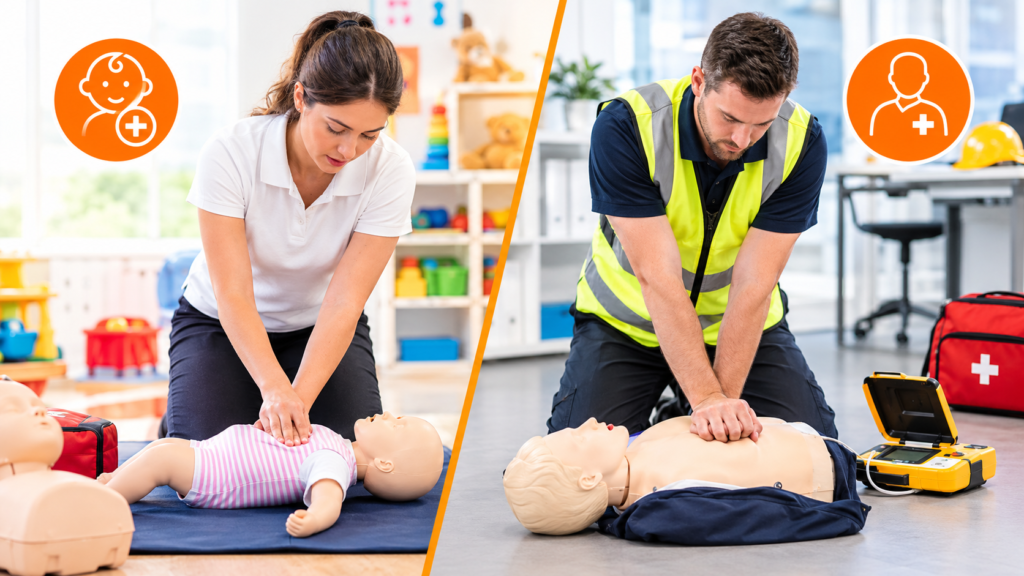
Little bodies are different from adult bodies, and that changes what you do in an emergency. Think about choking. A baby who is choking needs a different hold from an adult who is choking. During CPR, a child needs lighter chest pushes than an adult would. On the course, you practise these steps on baby and child dolls. That way, the movements feel familiar before you ever have to use them.
The government’s training rules say a full paediatric course should last at least 12 hours, not counting breaks. Many providers spread it over two days, which gives you time to practise without rushing. You can expect to cover:
The certificate stays valid for three years.
Emergency first aid at work is the training for people who look after adults in a workplace.
The emergency first aid at work course is the starting level of workplace first aid. It lasts at least six hours, and most providers run it in a single day. It suits lower-risk places such as offices and shops. You learn how to check an injured adult, give CPR, use a defibrillator, help a choking adult, stop bleeding and look after someone who is unconscious or in shock. It doesn’t go into detail about babies and children, because that’s not what it’s designed for.
The certificate stays valid for three years. Workplaces with higher risks, such as factories, may need the longer three-day First Aid at Work course instead.
Sometimes a table makes the differences easier to see, so here are the two courses next to each other.
| Category | Paediatric First Aid | Emergency First Aid at Work |
|---|---|---|
| Who you help | Babies and children | Adults at work |
| Course length | At least 12 hours (full course), often over two days | At least 6 hours, often one day |
| Who it suits | Childminders, nursery staff, nannies, teaching assistants, parents | Office and shop staff, team leaders, club and charity volunteers |
| Main skills | Baby and child CPR, choking, bleeding, burns, seizures, allergic reactions | Adult CPR, defibrillator use, choking, bleeding, shock, unconscious casualties |
| Certificate valid for | 3 years | 3 years |
| How to renew | Take the full course again | Take the course again |
| Yearly refresher | Recommended | Recommended |
| Guidance it relates to | Early Years Foundation Stage (EYFS) framework | Health and Safety Executive (HSE) first aid guidance |
Some childcare roles have to hold this certificate, and many other people take it because they want the peace of mind.
In England, childminders must hold a paediatric first aid certificate to register, and they have to keep it up to date while they’re registered. The certificate must come from a full course that meets the government’s training rules, and it must be renewed every three years. Nurseries and other early years settings follow a separate version of the EYFS framework. If you’d like to read the childminder rules for yourself, they’re in the EYFS framework for childminders.
Plenty of people outside these roles take the training too. Nannies, teaching assistants, parents and grandparents all do. Anyone who spends time with young children can take a paediatric first aid course, even if their role doesn’t ask for one. Choking and fits can happen anywhere, at home as much as at a nursery.
Most workplaces need at least one person who knows basic first aid.
Employers have to make sure their staff can get first aid help at work. To work out what that means, they carry out a first aid needs assessment. It shows how many first aiders the business needs and which course they should hold. Office staff, shop workers, receptionists, team leaders and volunteers often take the emergency course. The HSE guidance on first aid at work explains what applies to different kinds of workplace.
A school or nursery often needs both. Adult staff and young children share the same building, so it’s common for some team members to hold both certificates rather than just one.
If you’re still unsure, these questions can help you decide.
No. The emergency course covers adults, so it doesn’t meet the childcare rule. The paediatric course covers babies and children, so it won’t prepare you to help an adult colleague. If your role needs both, some training providers offer combined courses.
Both last three years. To renew, you take the course again before the date runs out. A short refresher each year is recommended, where it applies to your role, because it helps keep your skills fresh. It doesn’t replace the formal renewal, and it doesn’t make the certificate last longer.
Yes. The EYFS framework also describes a shorter emergency paediatric course of at least six hours. However, the framework says the certificate that childminders must hold has to come from a full course, which is at least 12 hours.
Many first aid courses at this level start from the basics, so you can often begin as a complete beginner. Entry rules can differ between providers and qualifications, so the course details are the best place to check.
Partly. Some courses let you do some of the study online before the classroom day. For childcare roles, though, the EYFS framework says the practical emergency skills must be taught face to face, so online study on its own doesn’t meet the rule.
A paediatric first aid course is the training that childcare roles, such as childminders, nursery staff and nannies, work towards, because it covers babies and children. The emergency first aid at work certificate is meant for workplace first aiders, because it covers adult casualties. Both certificates last three years. A full paediatric course lasts at least 12 hours, and the emergency course lasts at least six hours. The EYFS framework and HSE guidance explain which certificate applies to a particular role.