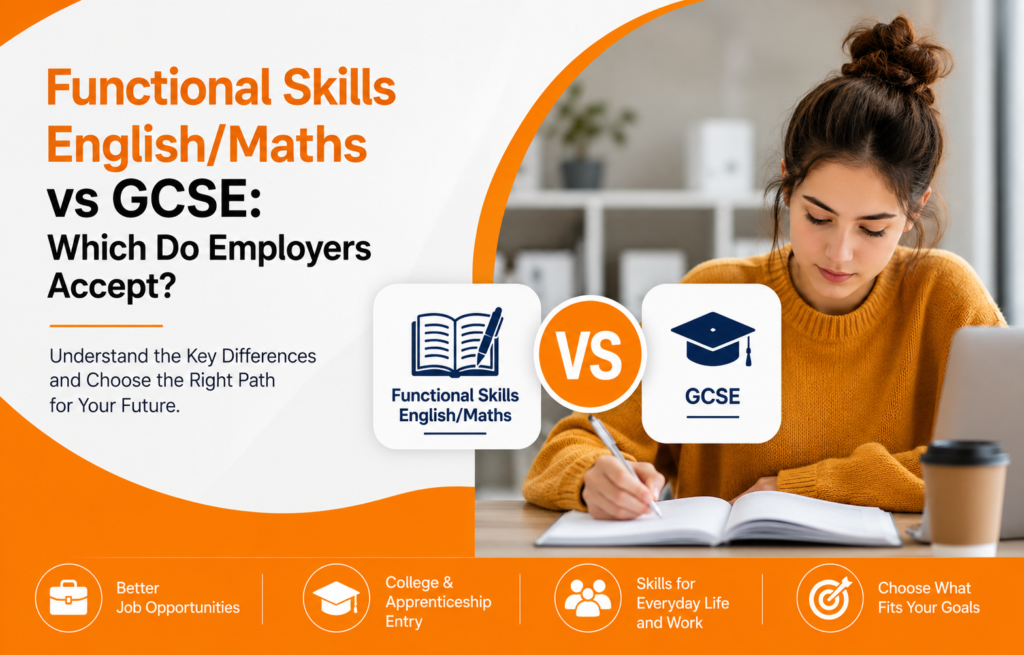
Struggling to decide between Functional Skills English and Maths or GCSE? You are not alone. This is a question that comes up again and again, whether you are an adult going back to study, a parent helping your child choose a path or even someone applying for a job that asks for “GCSE or equivalent”. On paper, they look the same, but they’re built differently, they’re taught differently, and they’re used differently once you go out to look for a job or apply to college.
Some employers don’t even realise the difference. Others have firm ideas about which one they will take. So before you sign up for either course, it helps to know exactly what you’re getting into, how long it takes, what it costs and most importantly if it’s going to get you where you want to go. This guide explains all of that in simple language, without the jargon that normally clutters up these comparisons.
Table of Contents
These courses are built around practical, everyday use of English and Maths rather than exam theory.
Functional Skills courses cover the kind of English and Maths people use in their everyday work and daily life. Think: writing an email that is clear, reading a set of instructions properly, figuring out change or making sense of a bill. There is no age limit, no set school term either.
Functional Skills English has three elements: reading, writing and speaking and listening. It’s got a maths element to it with number work, measuring and handling data. There are different levels from Entry Level 1 to Level 2. People tend to compare Level 2 to GCSE grade 4, which was previously known as grade C under the old system.
GCSE takes a broader, more academic route, and it’s the qualification most people are familiar with from school.
GCSE stands for General Certificate of Secondary Education. It’s the standard course taught across UK schools, typically to students between 14 and 16. GCSE English and Maths dig into more theory than Functional Skills does. You’ll write longer essays, study literature, and work through maths topics like algebra and geometry that go well beyond day-to-day number skills.
GCSE grading runs from 1 to 9. A grade 4 counts as a standard pass, and a 5 is seen as a strong pass. Unlike Functional Skills, GCSE exams sit on fixed dates, usually once or twice a year, and the course itself stretches out over a longer stretch of time.
This is the question most people want answered, so here it is straight.
Yes. Most UK employers treat Functional Skills English at Level 2 as equal to a GCSE grade 4. Job adverts that say “GCSE grade C/4 or equivalent” are, in most cases, happy to accept Functional Skills Level 2 instead. This holds true across retail, care work, construction, hospitality, and plenty of entry-level office roles.
Government bodies, colleges, and apprenticeship providers accept it too. Functional Skills Level 2 is often the go-to option for people applying to apprenticeships who didn’t get the GCSE grade they needed while at school.
Here’s where Functional Skills English tends to get accepted without any fuss:
Functional Skills covers most job requirements, but there are a few places where GCSE still has the upper hand.
Some universities and certain career paths ask for GCSE by name, not “an equivalent.” This shows up most in nursing, teaching, law, and various university degree courses. If university or a licensed profession is where you’re headed, check the entry requirements closely first, because not every institution treats Functional Skills as a stand-in.
Sixth form colleges and grammar schools can also lean toward GCSE grades when reviewing applications for A-levels. It’s not a hard rule everywhere, but it happens often enough that it’s worth a quick check with the school in question.
The right choice depends on your timeline and what you’re aiming for next.
Adult learners often find Functional Skills easier to manage since classes run part-time, sometimes online, and often in the evening. GCSE, by contrast, takes more months of commitment and follows a set exam calendar that can be tricky to work around alongside a job.
Time is usually the deciding factor for adults balancing study with everything else, so here’s the honest breakdown.
Depending on where you start and how much time you can dedicate each week, you can finish Functional Skills courses in as little as 6 to 12 weeks. There are lots of centres that run rolling exams so you’re not tied to one particular date.
GCSE, on the other hand, usually takes a full academic year, and sometimes longer for adults studying part-time. Exams happen in May or June, so missing that window can mean waiting almost a year for the next chance.
Money plays a big part in this decision, so it’s worth laying out clearly.
Functional Skills tends to cost less than a GCSE resit, particularly for adults studying outside of school. Many colleges and training providers offer these courses free, or at a reduced cost, for adults who don’t already hold a Level 2 pass in English or Maths. GCSE resits, especially private tuition or exam-only entry, usually cost more because the course covers more ground and exam boards charge separate entry fees.
People often ask which qualification looks better on a CV, so here’s a clear answer.
Both are recognised by the UK government and by Ofqual, the body that regulates exams and qualifications in England. Neither one counts as lesser in any official sense. The difference comes down to how a specific employer or institution has worded their requirement. If a listing says “GCSE or equivalent,” Functional Skills Level 2 satisfies that without any grey area.
Here’s a short summary if you just want the key points at a glance.
| Category | Functional Skills | GCSE |
|---|---|---|
| Study length | Weeks to a few months | About a year |
| Exam dates | Run through the year | Fixed yearly schedule |
| Content depth | Daily-life and workplace tasks | Wider ground, including essays and algebra |
| Employer view | Widely accepted | Widely accepted; some fields ask for it by name |
| Best for | Adults returning to work or needing quick proof of skills | Students aiming for university or licensed professions |
A few common slip-ups can cost you time, so it’s worth flagging them before you commit to either path.
One mistake is assuming every college or job treats both qualifications the same way. That’s not always true, so check the exact wording on a job advert or course page before enrolling anywhere. Another mistake is leaving the decision until the last minute, which can narrow your options if you need proof of English and Maths by a set deadline.
Skipping a proper skills check before starting is another one worth avoiding. A short assessment upfront tells you whether to start at Entry Level 3 or jump straight into Level 2, saving you weeks of studying content you already know.
A lot of learners worry that picking one course locks them out of the other, so here’s some reassurance.
You can move between Functional Skills and GCSE at almost any point. Finish Functional Skills Level 2 and later decide you need a GCSE grade for university or a specific career? You can still enrol on a GCSE course. The same works the other way around. Started GCSE and found the pace didn’t suit you? Switching to Functional Skills is common, especially among adults trying to balance work and study.
That flexibility means your first choice doesn’t have to be your final one. Plenty of people build their qualifications gradually, starting with a shorter course and adding a GCSE later if their plans change.
The right support during your course can shape how quickly you finish and how confident you feel going into exams.
Most training centres offer tutor help, whether in person or online, along with practice papers and mock tests. This applies whether you’re doing Functional Skills or GCSE. Adults tend to benefit from flexible class times, smaller groups, and one-to-one help on topics they find hard. It’s worth checking what support a provider offers before signing up, so you’re not left struggling halfway through the course.
A few quick answers to the questions that come up most often around this topic.
Not exactly the same, but it’s treated as equal in most cases. Functional Skills Level 2 is widely accepted as equivalent to a GCSE grade 4, especially for jobs, apprenticeships, and many college courses. The content and exam style differ, but the outcome carries similar weight for most purposes.
Yes, in most situations. If your goal is to meet a job or apprenticeship requirement, Functional Skills is often a quicker and less stressful route than sitting a GCSE resit. Just check the specific requirement first, since some courses or careers ask for GCSE by name.
Many learners finish within 6 to 12 weeks, depending on their starting level and how much time they can put in each week. Exams run on a rolling basis at many centres, so you’re not stuck waiting months for a fixed date like you are with GCSE.
Some will, but not all. Certain university courses, along with fields like nursing and teaching, name GCSE directly in their entry requirements and don’t treat Functional Skills as a substitute. Always check with the specific university or course before assuming either qualification will work.
Functional Skills focuses on practical, everyday skills, while GCSE covers more theory, longer writing tasks, and topics like algebra. Most learners find Functional Skills more manageable since it sticks to everyday tasks rather than exam-style essays and complex maths problems.
Choosing between Functional Skills English and Maths or GCSE really comes down to your goals and your timeline. Need a fast, flexible way to meet a job or apprenticeship requirement? Functional Skills is a solid choice that most employers accept without a second thought. Heading toward university or a licensed profession that names GCSE directly? It’s worth putting in the time for that qualification instead.
Either route opens doors, and neither one shuts them for good. You can always build on Functional Skills later, or come back for GCSE if your plans shift down the line.
Still not sure which course fits your situation? Bright Learning Centre offers guidance and course options to help you figure out the right path for your English and Maths qualifications.