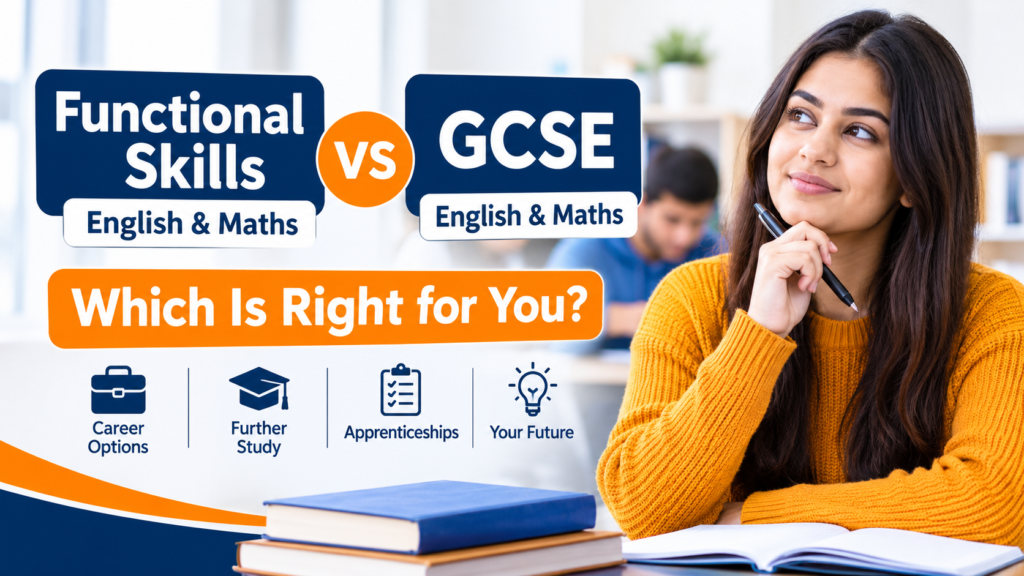
If you are weighing functional skills vs GCSE, you are not alone. Adults, apprentices and parents ask the same thing every week: do I need GCSE English, or will a Functional Skills qualification do the job? The answer depends on your age, your goal, and who is asking to see the certificate. This guide explains how the two compare, so you can choose with confidence.
Table of Contents
Functional Skills are practical qualifications in English and maths. They test how well you can use these skills in daily life and at work. In English, you read, write, speak and listen. In maths, you solve problems with numbers, measures, shapes and data.
They come in levels:
Functional Skills are pass or fail. There are no grades, and you move up when you are ready. Exams are regulated by Ofqual, the same body that oversees GCSEs in England.
A GCSE is a subject qualification that most students take at school at age 16. English Language and Maths are graded from 9 (the top) to 1. Grade 4 is a standard pass. Grade 5 is a strong pass.
GCSEs cover more content than Functional Skills. English Language includes reading and writing tasks that look at how texts work. GCSE Maths covers algebra, ratio, geometry and probability, and the papers are longer and harder. Most GCSE exams take place in the summer, with a resit in November for maths and English.
| Functional Skills | GCSE | |
|---|---|---|
| Style | Practical, work and life tasks | Academic, wider content |
| Result | Pass or fail | Grades 9 to 1 |
| Levels | Entry Level to Level 2 | One level (grades 9 to 4 count as Level 2) |
| Exam dates | Often more flexible | Set exam series each year |
| Best for | Adults, apprentices, work needs | School leavers, higher study needs |
This is the most common question about the functional skills equivalent. In most cases, yes. Level 2 Functional Skills is treated as equal to a GCSE grade 4 for many jobs, apprenticeships and college courses. Funding rules from the Department for Education (DfE) name both as ways to meet the English and maths requirement.
There is one point to keep in mind. The two qualifications are not the same in content. GCSE covers more ground. So some universities and a few employers ask for GCSE grade 4 by name. If you have a course or job in mind, ask the admissions team or employer before you decide, and get the answer in writing.
It depends on what you want to do next. Here are the most common cases.
The English and maths rules for apprentices have changed in recent years, so it pays to look at the current ones.
The DfE publishes new apprenticeship funding rules each academic year. Check the latest version on GOV.UK, or ask your training provider, before you make a plan. Rules can change, and your start date and age decide which version applies to you.
Functional Skills often suit you if:
Functional skills maths level 2 uses everyday problems: money, time, measures, percentages, simple charts and averages. A question might ask you to work out the cost of a job, read a bus timetable or compare two phone deals. The paper has a no-calculator section and a calculator section, and you must show your method. Many learners find it easier than GCSE Maths, but it still takes practice, and you need to pass the whole paper.
Functional skills English has three parts: reading, writing, and speaking, listening and communicating. You read short texts and answer questions. You write an email, a report or a letter for a set purpose and audience. You also take part in a short talk or group discussion. It rewards clear, plain writing, with correct spelling and punctuation.
GCSE often suits you if:
A GCSE takes more time. You study for a full course and sit set exams. If you are an adult with a busy week, that can be hard to fit in.
If the answers point both ways, start with the one that gets you moving. Many learners pass Functional Skills Level 2 first and add a GCSE later if a future course needs it.
In many cases, yes. Many employers, colleges and apprenticeship providers accept it. A few universities and some professional courses ask for GCSE grade 4. Always check with the place you are applying to.
They are different. Functional Skills uses practical tasks and has less content, so many learners find it easier to prepare for. Level 2 is still a full qualification, and you must pass it. Do not treat it as a shortcut.
Yes. Adults can study Functional Skills at Entry Level, Level 1 and Level 2. You can sit them in a local centre or learn in a class and book the exam with your provider.
It depends on age. Apprentices aged 16 to 18 at the start still need to meet the requirement. For those aged 19 or over, the pass is now optional for new starters, but check the latest DfE funding rules and your training provider for your own case.
Yes. Many learners take Functional Skills first and move on to GCSE later if they need it for college or university.
It depends on where you start and how much time you can give each week. A learner who starts at Level 1 may need longer than one who already works at Level 2. A tutor can check your level and suggest a study plan.
No. The condition of funding, which makes students keep studying English and maths, applies to young people aged 16 to 18 in funded study. Adults can choose to study for work, college or personal goals.
Many colleges accept it as proof of English and maths. Some courses ask for GCSE grade 4 by name. Read the entry requirements for your course, and ask the admissions team if the page is not clear.
In most cases you can sit the exam again after more study. Rules on resits depend on the awarding organisation and the exam centre, so ask your provider how and when you can try again.
Check the entry rules for your chosen job first. Many roles accept Functional Skills Level 2. Some careers, such as teaching and nursing, often ask for GCSE grade 4 or an approved equivalent, so look at the exact wording before you enrol.
The choice of functional skills vs GCSE comes down to your age, your goal and who needs to see your result. Functional Skills give a practical route with flexible steps, and GCSE gives a wider academic award that some courses ask for by name. If you are still unsure, speak to a tutor who can check your level and match it to your plan.
Bright Learning Centre in Leicester can help you find the right path. See our Functional Skills courses in Leicester or get in touch to talk about your English and maths goals.