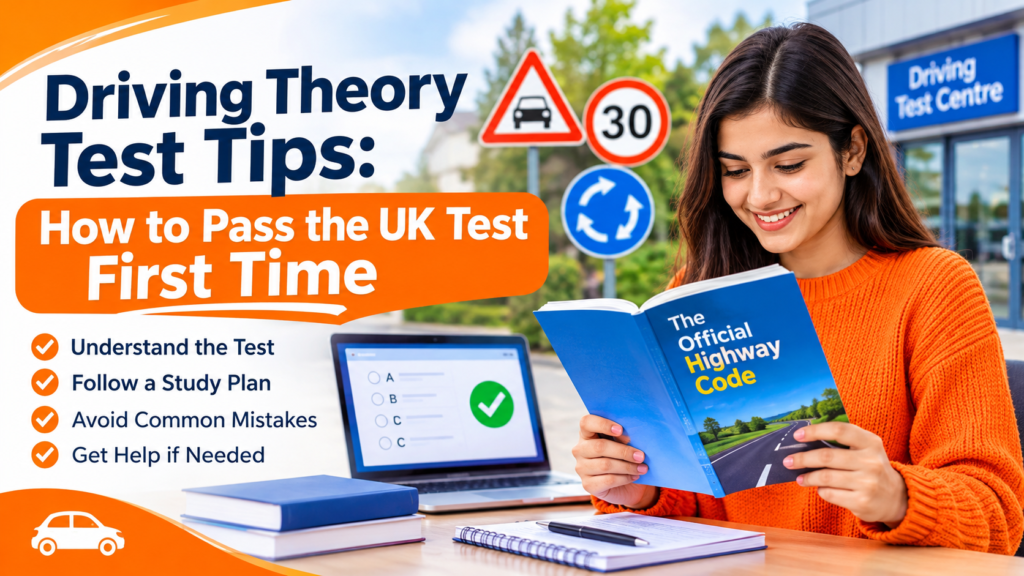
Nobody likes paying for a test twice. Yet fewer than half of learner drivers pass the car theory test each time they sit it, going by DVSA figures for 2024 to 2025. The good news is that the test is not a mystery. It has a fixed shape, a fixed pass mark, and a set of topics that stay the same, so a plan beats luck every time.
This guide gives you clear driving theory test tips that you can use from your first day of study. You’ll see how the two parts of the test work, how to build a study plan, which mistakes trip people up, and what help you can ask for if English is not your first language or reading is hard for you. Short answers to common questions sit at the end, so you can check the small details before you book.
Table of Contents
The theory test has two parts, and you take both on the same day. You must pass both to pass the test. If you pass one part and fail the other, you sit the whole test again.
This part comes first, and it checks what you know about the rules of the road.
You get 50 questions and 57 minutes. Most questions ask for one answer, and a few ask for more than one. A few questions are built around a short story about one driver. You need 43 right to pass, which means you can get seven wrong. The topics include road signs, speed limits, stopping distances, motorways, vehicle checks, and what to do after a crash. You can flag a question and come back to it before the time runs out.
After a short break, you watch video clips filmed from a driver’s seat. Your job is to spot trouble before it turns into an emergency.
The hazard perception test has 14 clips, and each one runs for about a minute. You click the mouse when you see a developing hazard. That’s something that would make a driver slow down or change direction. A parked car isn’t a hazard while it stays still, but it becomes one when its door opens or it starts to pull out. You can score up to five points on a hazard, and the sooner you click, the more points you get. The top score is 75, and you need 44 to pass. You see each clip once, so stay focused.
A little planning stops silly problems on the day.
You book on the gov.uk website, and you need a provisional driving licence to do it. The fee is £23 at the time of writing, so check gov.uk before you pay, and stay away from sites that add extra charges. If you need to move your test, give at least three full working days’ notice, or you lose your fee. You can take the test from your 17th birthday. If you’re looking for a driving theory test in Leicester, learners can sit close to home; the booking page lists the centres near you, so pick the one that’s easiest to reach. Take your photocard licence with you. If the centre can’t check who you are, it cancels the test and keeps your money.
Good driving theory test tips only work when you turn them into a routine. Here’s a plan that fits into four weeks. If you have less time, squeeze the weeks together. If you have more, stretch them out.
Thirty minutes each day beats one long weekend of cramming. If you’d like a tutor to guide you, a driving theory course gives you lessons, practice tests, and help with words you don’t know.
Most people who fail don’t lack brains. They slip on a few small habits, and each one is easy to fix.
You can ask for help when you book, so it’s worth knowing what’s on offer before you pick a date.
A driving theory test in other languages is not on offer in England, Scotland, or Wales. Since April 2014, you must take the test in English or Welsh, and you can’t bring a foreign-language interpreter. Northern Ireland has its own rules, so check the nidirect website if you plan to test there. Here’s the help you can ask for:
If English is your second language, revise in two steps. First, use a translated study guide or app in your own language, so the rules make sense. Second, practise the same questions in English, because that’s the language on test day. Make a small word list with terms like junction, overtake, roundabout, pedestrian, and stopping distance. A class helps too. Many learners build their reading and listening by joining an ESOL course next to their practice.
Here are quick answers to the questions that learners ask most.
You can get seven questions wrong out of 50. In hazard perception, you need 44 points out of 75.
You must pass both parts in the same sitting. If you fail either one, you sit both parts again.
You have to wait at least three working days. Use that time to study the topics you missed.
Your pass certificate stays valid for two years. You must pass your practical test in that time, or you sit the theory test again.
A clear plan, steady practice, and a calm start on the day give you the best chance of passing first time. Use these driving theory test tips, sit mock tests until you pass them with room to spare, and book when you feel ready.
Disclaimer: This blog gives general information. Test rules, fees, and support options can change, so check gov.uk or the DVSA before you book.

