
Ten years in this industry has taught me one thing: a lapsed SIA licence causes more lost income than almost any other compliance mistake a security worker can make. Every year, thousands of guards, door supervisors, and CCTV operators miss their renewal window and end up unable to work for weeks. This guide walks you through the entire SIA licence renewal process, based on what I have seen work — and fail — across a decade of helping security professionals stay compliant.
Table of Contents
Your SIA licence is what makes it legal for you to work in a licensable security role in the UK. It carries an expiry date, and that date does not move on its own.
SIA licence renewal is the process of applying for a fresh licence before your current one runs out, so you can keep working without any break in your legal status.
Most licences last three years from the date of issue. This covers door supervisors, security guards, CCTV operators, close protection officers, and vehicle immobilisers alike.
I have worked with guards who assumed their employer handled renewal automatically. It does not. The responsibility sits with you, the licence holder, every single time.
Timing is where most people go wrong. I have seen good, experienced officers lose weeks of work simply because they left this too late.
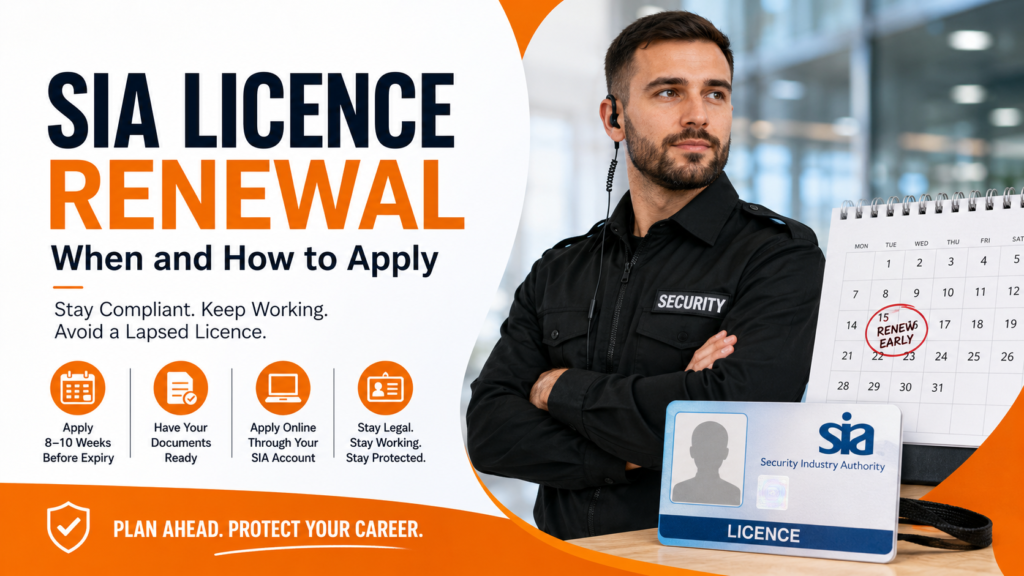
The SIA recommends starting your renewal application 8 to 10 weeks before expiry. This gives enough time for document checks, background verification, and card production.
| Time Before Expiry | What to Do |
|---|---|
| 12 weeks | Start gathering your documents and confirming your details are correct. |
| 8–10 weeks | Submit your renewal application. This is the safest window. |
| 4 weeks | Treat this as urgent if you have not yet applied. |
| After expiry | You cannot legally work in a licensable role until your new licence arrives. |
Missing paperwork is the number one reason applications stall. Having everything ready before you start saves real time later.
I always tell the guards I train to scan every document the day they decide to renew, not the week before submitting. It removes a huge source of last-minute stress.
The application itself runs through the SIA’s online portal, and it follows a fairly straightforward path once your documents sit ready.
After years of reviewing applications alongside security businesses, the same errors show up again and again.
Small mismatches between your name on the application and your ID documents cause automatic flags.
Documents older than three months often get rejected outright.
This is the biggest one. A late start leaves no room for a request for extra documents.
If you run a security business, our guide on managing your team’s licence compliance covers how to track renewal dates across multiple staff members without the spreadsheet chaos.
If your current licence expires before your new one arrives, you must stop working in any licensable role immediately.
Continuing to work without a valid licence breaks the law and puts both you and your employer at risk of penalties.
At this point, your application technically becomes a fresh application rather than a renewal, which can sometimes mean a longer wait than the standard renewal window.
This single fact is exactly why the 8-to-10-week rule exists. It is not a suggestion; it is a buffer built around real processing times.
For a deeper look at what compliant document handling looks like across a full security operation, see our piece on SIA compliance for security businesses.
Renewing your SIA licence does not need to feel stressful once you know the timeline and have your documents ready.
Start 8 to 10 weeks ahead, gather your paperwork early, and track your application status through your online account.
A well-planned SIA licence renewal protects your income, keeps you working without interruption, and keeps your record clean for every future application.
If you want a head start on your training requirements before your next renewal, our SIA training course directory lists every current option by licence category.
The cost of renewing an SIA licence is set by the Security Industry Authority (SIA). Check the official SIA website before applying, as fees may change over time.
Most SIA licence renewal applications are processed within a few weeks, although the exact time depends on identity checks, criminal record checks, and whether all required documents have been submitted correctly.
Yes, you can apply after your licence expires. However, you cannot legally work in a licensable security role until your new licence has been approved and issued.
Some licence holders, including Door Supervisors and Security Guards, must complete the required refresher training before renewing their licence. Check the latest SIA guidance for your licence type.
Yes. You can complete your SIA licence renewal through your online SIA account by updating your details, uploading the required documents, paying the fee, and tracking your application.
You typically need proof of identity, proof of address, right-to-work evidence (if required), and any training certificates needed for your licence category.
The SIA recommends applying around 8 to 10 weeks before your current licence expires to reduce the risk of delays.
Yes. You can log in to your online SIA account at any time to track the progress of your renewal application.
If your application is refused, the SIA will explain the reason. Depending on the circumstances, you may be able to correct the issue, provide additional information, or submit a new application.
No. Once your licence expires, you must stop working in any role that requires an SIA licence until a new valid licence has been issued.
Yes. Applying before your licence expires is recommended. Starting your renewal 8–10 weeks early gives enough time for processing and helps avoid any interruption to your work.
The SIA carries out the necessary background checks as part of the renewal process. In some cases, additional checks or information may be required.