
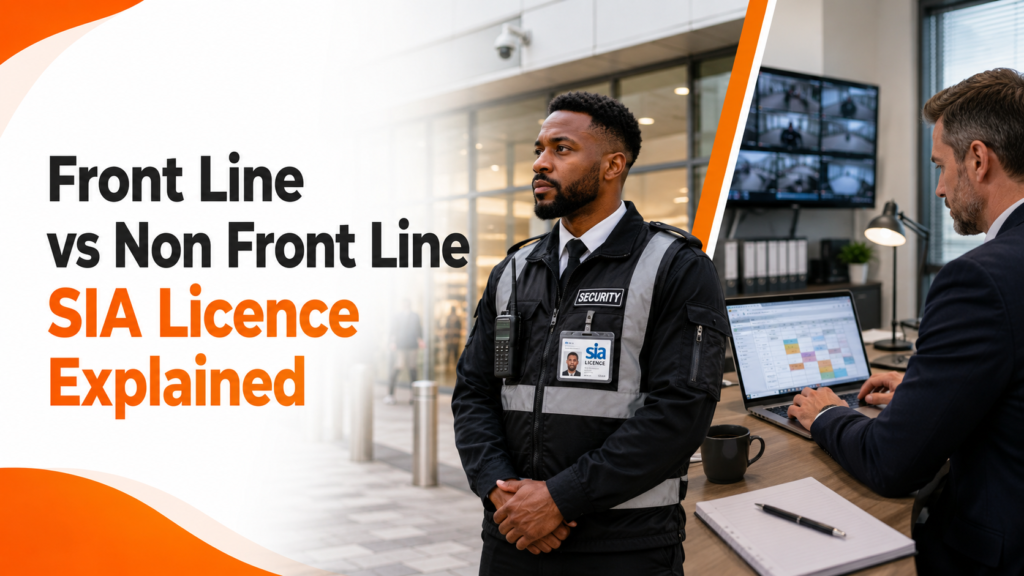
Quick question. If someone asked you right now which security badge your job needs, could you answer without hesitating? A lot of people can’t, and that’s fair enough, because the front-line/non-front-line SIA licence system does a bad job of explaining itself. Two names, one word apart, covering two completely different jobs.
On one side you’ve got the door supervisor standing outside a club at midnight, checking IDs, deciding who gets in. On the other side, someone sitting at a desk, building next week’s shift rota, dealing with staffing headaches, never once standing at a door. Both are security jobs. Both need a badge. Just not the same one.
That’s really all this guide is trying to sort out for you — which badge is yours, why it matters, and how to keep it from quietly expiring while you’re not looking. Once you know the two main SIA licence types, the rest of this whole security licence UK system starts making a lot more sense.
Let’s be honest about why any of this matters in the first place. A badge is proof. It tells your employer, and anyone you deal with on the job, that someone checked your background and you sat through the right training before you were let loose. Take that system away and you’d have people calling themselves security guards with zero checks behind them, which is exactly the kind of thing nobody wants near a busy shop or a packed event.
So stick with us here. By the end of this, you’ll know exactly which badge fits the work you actually do, how to go about applying, and what keeps that badge alive once you’ve got it.
Table of Contents
You’re going to see “SIA” mentioned a lot, so let’s clear that up early. It’s the Security Industry Authority, and its whole job is watching over private security work across the UK. Not glamorous, but necessary.
Here’s the bit that trips people up most: you need a valid badge before you can legally start certain security jobs. Not after. Before. Skip that step and you’re looking at fines, maybe worse. Your badge is your proof card, plain and simple — it says you passed a background check and got the training done properly.
When someone’s wearing their badge on shift, it sends a quiet signal — this person can be trusted if something kicks off. That trust comes from a background check that digs into someone’s record, so only the right people get through. Which is exactly what keeps shops, offices, and event spaces feeling safe for the rest of us walking through the door.
Think about the guard standing by the entrance. Or the one doing the same slow lap around a warehouse, hour after hour, night after night. That’s front-line work. It’s the badge most guards end up carrying.
The card itself is small, plastic, not far off from a driving licence. Your name’s on it, your photo, your licence number, an expiry date. And here’s the thing — you can’t tuck it away in a pocket. It has to be visible while you’re working, somewhere people can actually see it.
So who needs one? If your job looks anything like the list below, front-line is yours:
Look at that list again. Every single one puts the worker right in the middle of things — face to face with the public, or right there as something happens live. That’s exactly why the training for this badge goes deeper. Guards need to know how to talk someone down before it escalates, spot trouble early, and know the exact moment to call for backup instead of handling it alone.
Now flip it completely. Picture the person who owns the security company. Or the one building schedules all day, fielding phone calls about who’s covering Friday night. That’s non-front-line work.
This badge doesn’t come as a card you pin to your shirt. It’s an official letter, or these days more often a digital approval sitting in your account. You just keep it on file, proof that you’re cleared to run a security business or manage a crew of guards.
This one’s yours if your role looks more like:
Same pattern as before, just flipped. These are all jobs done behind the scenes. Writing safety guides, sorting contracts, ordering kit — not standing at the door yourself.
Sometimes a table just makes it click faster than a paragraph ever could.
| Feature | Front-Line Badge | Non-Front-Line Badge |
|---|---|---|
| Physical form | Plastic card worn on the body | Paper letter or digital notice |
| Direct guarding work | Allowed | Not allowed |
| Hands-on training | Required | Not required |
| Background check | Required | Required |
| Where the work happens | Doors, sites, patrol routes | Offices and desks |
A front-line worker is on their feet most of the shift, walking a patrol or glued to a wall of screens. A non-front-line worker’s more likely answering the phone and shuffling next week’s rota around.
One thing worth knowing: if a manager ever steps in to cover a door shift themselves, even just for a night, they need a front-line badge for that shift too, on top of the one they already carry.
The steps look pretty much the same either way. The training part is really the only thing that changes.
Your badge won’t last forever. Three years, then it’s done. Worth setting a reminder now rather than scrambling about it later.
Start your SIA licence renewal a few weeks before your badge is due to run out — not the week before, a few weeks. That gap gives you breathing room so you’re not stuck waiting on approval mid-shift. When you actually sit down to sort your SIA licence renewal, log back into your account, fill in the updated form, pay the fee, finish whatever refresher training the SIA asks for.
Miss that SIA licence renewal date and your badge just stops working. No grace period, no bending the rules. Working with an expired one is against the law, full stop, so you’d be stuck sitting out until the new one lands.
Easiest fix? Mark the expiry date on your calendar the same day you get the badge. Don’t rely on remembering it three years from now.
Getting the badge isn’t really the finish line. A few habits are worth keeping up once you’re actually working.
Really, it comes down to one question. What do you actually do at work each day?
These are the questions that come up over and over when people try to make sense of the front-line/non-front-line SIA licence setup on their own.
Yes, and honestly, quite a few people do. It’s common among small business owners who run their own team but still cover a shift when someone rings in sick.
No practical training here, though you’ll still go through a background check before the SIA signs off on it.
Depends on the person, but most wait a few weeks once training and identity checks are sorted. Apply early. Save yourself the gap.
You’d need a front-line badge and the training that comes with it, since your office badge doesn’t stretch to cover hands-on guarding.
No. Badge needs to be approved first, no matter how close the application looks to being done.
Usually quicker. You’ll still pay a fee and might need refresher training, but a lot of the first-time identity checks get skipped.
You stop working, right then. An expired badge means you’re no longer approved, simple as that. Which is exactly why starting renewal early is worth the small bit of effort.
At the end of the day, it really comes down to one question. Are you working directly with the public during security duties, or are you running things from behind a desk? Front-line workers need the hands-on training because they’re dealing with people, and situations, face to face. Non-front-line workers are more about keeping the business and the team organised from behind the scenes.
Both matter. Both keep the whole industry playing by fair, clear rules. Still not sure which one’s yours? A trusted source like SIA Security can talk you through it and point you toward the right training and the right application steps.