If someone just told you that you need to pass a B1 English Test and you have no clue what that means, don’t worry, you’re in good company. Most people hear this term for the first time while filling out a visa form, applying for citizenship, or signing up for a course, and it lands on them out of nowhere. The name sounds official, maybe even a little scary, but once you know what it’s checking and why it exists, it stops feeling like such a big deal.
This guide walks you through what the test looks at, who needs to take it, what the exam day looks like, and how to get ready without losing sleep over it.
Grab a cup of tea and read through this. By the end, you’ll know exactly what’s being asked of you and what to do next.
Table of Contents
Let’s start with the basics. The B1 level comes from something called the Common European Framework of Reference for Languages, or CEFR. It’s a system with six levels, starting at A1 for someone just starting out and going up to C2, which is close to speaking like a native. B1 lands right in the middle. You’re past the beginner stage, but you’re not fluent either. Think of it as the “I can hold a conversation, but I still trip over some words” stage.
At this level, you’re expected to manage a few things without too much trouble:
That’s the general idea. But the exam itself splits this into separate sections, which we’ll get to shortly.
Here’s the thing, not everyone learning English needs to bother with this test. It mostly comes up for people dealing with paperwork or specific requirements, not just casual learners brushing up on their skills.
You’ll likely need this test if you fall into one of these groups:
Not sure if your situation needs this specific level? Double-check the official guidance for your visa category or course. Requirements shift depending on what you’re applying for, so it’s worth the extra five minutes to confirm.
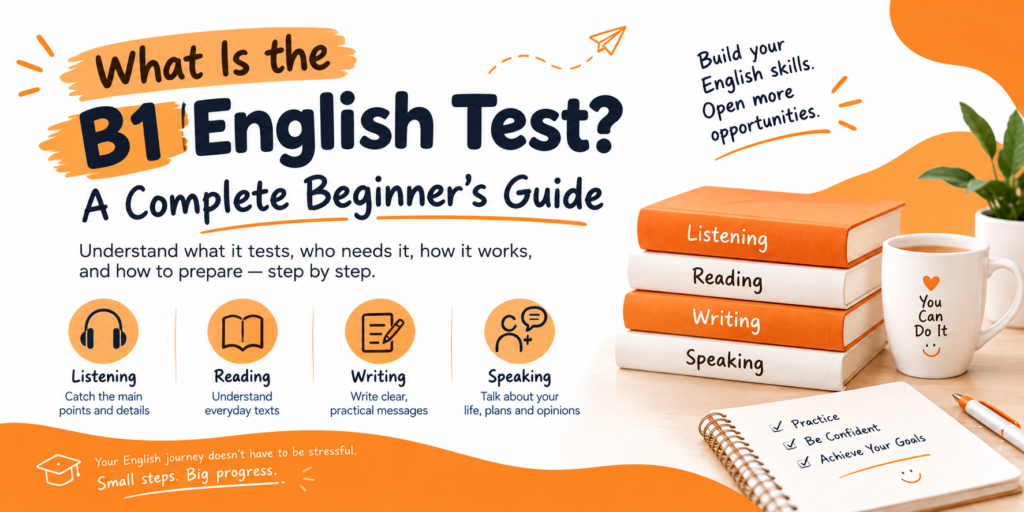
Almost every version of this test, no matter which company runs it, checks the same four skills. Once you know what’s coming in each part, exam-day nerves tend to settle down quite a bit.
You’ll hear short recordings, maybe a phone call or an announcement, and then answer questions about what was said. The speech isn’t rushed, but you do need to catch the small details, not just get the gist of it.
This section gives you short pieces of text, like a notice, an email, or a basic article, and asks you questions about them. Nothing academic here, just everyday language you’d run into in daily life.
You’ll usually write something short and practical, like a letter, an email, or a few lines about your own life. Your grammar and spelling do matter, but nobody’s expecting you to write like a novelist.
For this part, you’ll talk with an examiner, or sometimes with another person taking the test, about ordinary topics. You might be asked to describe a picture, answer a few questions about yourself, or talk about something simple for a couple of minutes.
Timing and structure change slightly between exam boards, so check the format for the specific exam you’re booking before your test date.
You don’t need to lock yourself away studying for months. A calm, steady routine beats last-minute cramming every single time.
A few things that genuinely help most people preparing for this:
Working with a tutor for a bit can also make a real difference, since they’ll catch mistakes you’d probably miss on your own and point you toward the areas that need the most work before test day.
After the exam wraps up, you’ll wait on your results before moving forward with your visa, citizenship, or course application. This can take anywhere from a few days to a few weeks, depending on which board ran your exam and where you took it.
Pass, and you get a certificate showing your level, which you then hand over with the rest of your documents. Don’t pass on the first go? Most boards let you book another attempt after a short wait, so one bad day doesn’t shut the door on you completely.
Most versions run somewhere between two and three hours once you add up listening, reading, writing, and speaking. Some boards test speaking on a different day entirely, so check the schedule for your exam ahead of time.
Some boards do offer online options, but a lot of visa and citizenship applications only accept results from an approved, in-person test centre. Check what your application needs before you book anything online.
Yes, and there’s usually no strict cap on how many times you can retake it. You’ll typically need to wait a short period, maybe a few days or weeks, before booking again. This varies by board, so check theirs directly.
Not quite. IELTS gives you a band score across a much wider range, while a B1 test just checks whether you hit one specific level on the CEFR scale. Some boards do have an IELTS option that lines up with B1, so ask which one your application wants.
Prices vary a fair bit between exam boards and test centres, so shop around before committing to one. Costs can also change depending on whether speaking and listening are tested together or separately.
Most certificates hold up for around two years, though this depends on the board and what you’re using it for, like a visa or a course application. Always double-check the validity period for your specific situation.
Plenty of people pass without one, but a tutor can help you find weak spots faster and build up confidence for the speaking section, which trips up a lot of test takers. Self-study works fine too, as long as you stay consistent with it.
The B1 English Test doesn’t need to feel like some mystery you can’t crack. It’s checking your listening, reading, writing, and speaking at a middle level, and it comes up most often for visas, citizenship, jobs, and certain courses. Practice all four skills a little at a time, get familiar with the exam format, and you’ll likely walk into test day feeling a lot calmer than you expected.
Looking for some guidance before your exam? Bright Learning Centre runs courses built to help you strengthen exactly the skills you’ll need to pass with confidence.