
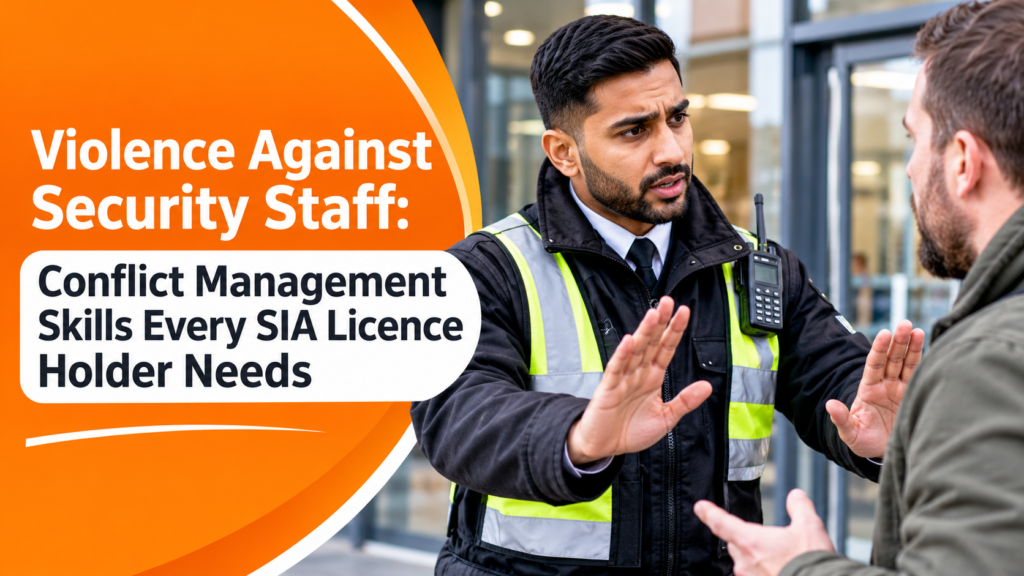
A customer is refused entry. A shopper is asked to leave a store. A visitor becomes angry after being told that a site is closed. These situations can happen during a normal security shift. How a security professional responds can affect whether the situation ends calmly or becomes dangerous.
Good conflict management security guard skills help security staff recognise warning signs, communicate clearly and reduce the risk of violence. These skills are important for Door Supervisors, security guards and other people working in the private security industry.
Violence at work is a concern for many SIA licence holders. Research published by the Security Industry Authority (SIA) found that 43% of licence holders surveyed said they were having to deal with increasing levels of violence at work. This is a survey finding, not a count of every incident across the security industry.
This guide explains how to recognise aggression, calm difficult situations, respond to physical threats, stay safe when working alone and report incidents correctly.
Table of Contents
Conflict management means using communication, awareness and good judgement to prevent disagreements from becoming more serious. It involves understanding why someone is upset and choosing a safe way to respond.
For example, a Door Supervisor may refuse entry to someone who appears too drunk to enter a venue. The person may become angry and start shouting. Instead of arguing, the Door Supervisor can explain the decision calmly, keep a safe distance and ask a colleague for support if needed.
The SIA conflict management training specification covers three main areas:
These skills are useful because security staff often need to enforce rules while dealing with people who may be angry, upset or under the influence of alcohol.
The Health and Safety Executive (HSE) describes work-related violence as an incident in which a person is abused, threatened or assaulted in circumstances relating to their work. This means workplace violence can include verbal threats as well as physical attacks.
The SIA has published research and information about assaults and injuries involving licence holders. It is important to understand what these figures mean.
The SIA’s 2026 consultation announcement refers to research in which 43% of licence holders surveyed said they were dealing with increasing levels of violence at work. The finding highlights the experiences reported by those who took part in the research.
It does not mean that 43% of all licence holders were assaulted, and it should not be presented as a national assault rate.
SIA assault and injury information also needs careful reading. Not every incident is reported directly to the SIA. Some incidents may be reported to the police instead. In addition, one person may hold more than one SIA licence, which can affect how figures are counted.
The key point is that violence and aggression are concerns for people working in security. Staff should take threats seriously and report incidents, even when they do not result in physical injuries.
Aggression does not always begin with physical action. A person may show signs of frustration or anger before a situation becomes unsafe. Recognising these signs can give a security professional time to change their approach or ask for help.
Remember that these signs do not prove someone will become violent. They are reasons to pay attention and reassess the situation.
If you notice these signs, avoid making the situation worse. Keep your distance, use a calm voice and follow your workplace procedures.
Communication is one of the most important parts of conflict management. The aim is not to win an argument. It is to understand the problem, explain what needs to happen and keep people safe.
SIA conflict management training covers verbal and non-verbal communication. These skills need practice, as people may react differently in stressful situations.
A person who feels ignored may become more frustrated. Listening carefully can help reduce tension.
Useful ways to show that you are listening include:
Listening does not mean that you must change a security decision. You can listen while still following the rules of the site.
Your body language can affect how another person responds. An aggressive stance may increase tension, even when your words are calm.
Try to:
Do not block someone in or stand where you could be trapped. If you feel unsafe, move away and ask for assistance.
De-escalation means taking steps to reduce anger and tension before a situation becomes more serious. There is no single method that works every time, but the following approach can help.
For example, if a visitor is angry because a building is closed, you could explain the opening hours and tell them when they can return. If they continue shouting or make threats, follow your workplace procedure and request support.
This approach is general guidance. It does not replace your employer’s procedures or the practical training required for your role.
Security staff may face shouting, insults and threats while carrying out their duties. It can be difficult to remain calm, especially when someone is being personally abusive.
However, arguing back can make the situation worse.
If someone starts using abusive language:
For example, if a customer is shouting at a retail security guard, the guard can explain the store’s decision once and avoid repeating the same argument. If the customer becomes threatening, the guard should move to a safer position and call for assistance.
Verbal abuse should not be treated as an ordinary part of the job. Report it according to your employer’s procedure.
The following examples are fictional and show how conflict management skills may be used during a shift.
A man arrives at a venue and appears heavily affected by alcohol. The Door Supervisor refuses entry. The man becomes angry and starts shouting.
The Door Supervisor explains the decision in a calm voice and avoids arguing. They keep a safe distance and ask a colleague to help manage the queue. If the man continues to threaten staff, they follow the venue’s safety procedure and request further assistance.
A customer is asked to leave a shop after abusing a member of staff. The customer starts pacing and shouting.
The security guard explains the decision clearly, avoids personal comments and keeps a safe route available. The guard informs a manager and signals a colleague for support. If the customer becomes physically threatening, the guard moves to safety and follows the emergency procedure.
Both examples show why calm communication and teamwork matter. The security professional should not put themselves or others at unnecessary risk to win an argument.
Sometimes a situation becomes physically dangerous despite attempts to calm it down. At this point, the priority is to protect yourself and other people.
A security worker should never treat physical intervention as a way to punish someone or respond to insults. The safest option may be to withdraw, observe and wait for help.
Physical intervention is a serious matter. It can cause injury to the person involved, the security worker and anyone nearby. It should not be used to deal with verbal abuse alone.
The SIA’s physical intervention training requirements are linked to the Door Supervisor qualification. The training covers areas such as personal safety, physical intervention skills, escorting and the risks that may arise during an incident.
The training also highlights the importance of using physical intervention as a last resort and understanding the risks of unsafe restraint. These include positional asphyxia and the dangers of holding someone in a position that affects their breathing.
People working under other licence categories should not assume that they have the same physical intervention training as Door Supervisors. Additional training may be needed, depending on the role and the employer’s risk assessment.
An SIA licence does not give a security professional extra powers to use force. Security staff must follow the law that applies to their circumstances.
In England and Wales, the law recognises certain situations in which reasonable force may be used, including self-defence, defending another person and preventing crime. Section 3 of the Criminal Law Act 1967 and section 76 of the Criminal Justice and Immigration Act 2008 are relevant legal provisions.
Whether force is reasonable depends on the circumstances. It must not be disproportionate to the situation. The law and its application can differ across the UK, so security staff should follow current legal guidance and their employer’s procedures.
This information is a general explanation, not legal advice. Anyone involved in a serious use-of-force incident may need independent legal advice.
Some security professionals work alone, especially during night shifts, patrols or duties at smaller sites. Working alone can make it harder to get help quickly if a situation becomes dangerous.
The HSE explains that lone workers may be more vulnerable because there is no nearby colleague to provide immediate support. This does not mean every lone-working role is unsafe, but employers need to assess the risks and put suitable controls in place.
Useful safety measures include:
For example, a lone security guard carrying out a night patrol may notice someone trying to enter a restricted area. The guard should follow the site procedure, contact the control room and avoid putting themselves in danger by approaching the person without support.
A CCTV Operator may also help by observing an incident and alerting on-site staff or the police, rather than placing themselves in direct danger.
Employers should assess lone-working risks and provide suitable training, supervision and communication arrangements. Read the HSE guidance on protecting lone workers from violence.
Conflict management is not always an individual task. Colleagues, supervisors and control room staff can help prevent a difficult situation from becoming more dangerous.
Teamwork may involve:
For example, if a Door Supervisor is dealing with an aggressive visitor, another team member may help manage the entrance and contact a supervisor. This allows the first Door Supervisor to focus on communication and personal safety.
Good teamwork depends on clear roles. Staff should know who is responsible for contacting emergency services, managing the area and reporting the incident.
Reporting an incident helps employers understand what happened and identify ways to reduce future risks. Security staff should not assume that verbal abuse or threats are too minor to report.
After an incident:
Keep the report factual. Avoid personal opinions or guesses about what someone intended to do.
RIDDOR is the Reporting of Injuries, Diseases and Dangerous Occurrences Regulations. It places reporting duties on employers and certain other responsible people.
Work-related violence must be reported to the HSE when it results in death, a specified injury or a physical injury that means a worker cannot carry out their normal duties for more than seven days.
An injury that prevents a worker from carrying out normal duties for more than three days must be recorded, even when it does not meet the over-seven-day reporting threshold.
Not every verbal threat or incident needs to be reported to the HSE under RIDDOR. However, workers should still follow their employer’s internal reporting procedure.
For further details, read the HSE guidance on reporting and learning from work-related violence.
If someone is in immediate danger, call 999. For non-emergency police matters, use 101 or the relevant online reporting service. Workers affected by an incident may also benefit from confidential support or counselling.
Conflict management is an important part of SIA licence-linked training. The training helps learners understand how to prevent conflict, communicate with people and respond to difficult situations.
The SIA’s conflict management specification includes core learning and role-specific content. The practical examples depend on the licence category.
Security officer training includes practical situations involving enforcement, defusing conflict, confronting difficult behaviour and higher-risk situations. These activities help learners understand how to respond to problems that may arise during security duties.
Door Supervisor training includes situations such as refusing entry, asking people to leave a venue and dealing with arguments or fights. Learners also study personal safety and physical intervention as part of the relevant qualification requirements.
CCTV Operators should check the content of their specific qualification with their training provider. They may need to identify developing incidents, communicate clear information and alert the appropriate staff or emergency services.
The SIA launched a consultation on proposed changes to security licence-linked qualifications on 28 August 2026. The consultation closed on 23 October 2026.
One proposal was to include more real-life scenarios in conflict management training for security guarding operatives. The SIA also proposed a new advanced physical intervention standard for higher-risk deployments.
These were proposals in the consultation, not changes that should be described as current training requirements. The SIA announcement stated that final specifications were expected in winter 2026, with new qualifications planned for later in 2027. Check the official SIA announcement for updates before relying on any new requirements.
If you are planning to enter the security industry, choose training that matches the licence category and job role you want to work in.
Even experienced security professionals can make mistakes when dealing with an angry person. Some responses may increase tension or put staff at greater risk.
Learning from these mistakes can help security staff make safer decisions during future shifts.
Conflict management is the use of communication, listening skills and good judgement to prevent disagreements from becoming more serious. It helps security staff respond to difficult behaviour while protecting themselves and others.
Security guards may deal with people who are angry, upset or under the influence of alcohol. Conflict management skills help them recognise warning signs, communicate clearly and reduce the risk of violence. SIA research published in 2026 found that 43% of licence holders surveyed said they were dealing with increasing levels of violence at work.
Stay calm, keep a safe distance and listen to what the person is saying. Explain the decision clearly, avoid arguing and request help if the risk increases. If you feel unsafe, move away and follow your workplace emergency procedure.
Common techniques include active listening, empathy, a calm voice, non-threatening body language, keeping a safe distance and offering clear choices where possible. Security staff should also know when to stop the conversation and ask for help.
Yes. Conflict management is included in SIA licence-linked training for relevant licence categories, including security guarding and Door Supervision. The exact learning and practical scenarios depend on the qualification. Check the current SIA specification and course details with your training provider.
Physical intervention must only be considered when it is lawful and necessary in the circumstances. It must be reasonable and must follow the person’s training and workplace procedures. An SIA licence does not give someone extra powers to use force.
Move to safety, arrange medical help and contact the police if needed. Inform your employer, record what happened and include any injuries or actions taken. You can also ask your employer for support after the incident.
Follow the lone-working risk assessment, agree check-in times, carry working communication equipment and learn the site’s emergency procedures. Avoid approaching a dangerous situation without support. Report any repeated threats or safety concerns to your employer.
Violence against security staff is a serious workplace concern. Strong conflict management security guard skills can help security professionals recognise warning signs, listen carefully and reduce tension before a situation becomes more dangerous.
Stay calm, keep a safe distance, use clear communication and ask for help when needed. If a situation becomes physical, put safety first and follow your training and the law. Always report incidents and seek support after a difficult experience.
Bright Learning Centre provides security training in Leicester for people looking to develop their skills and work towards an SIA licence. If you are considering a career in the security industry, explore the SIA training courses at Bright Learning Centre to learn more about the available training options.